


- Afhalen na 1 uur in een winkel met voorraad
- Gratis thuislevering in België vanaf € 30
- Ruim aanbod met 7 miljoen producten
- Afhalen na 1 uur in een winkel met voorraad
- Gratis thuislevering in België vanaf € 30
- Ruim aanbod met 7 miljoen producten





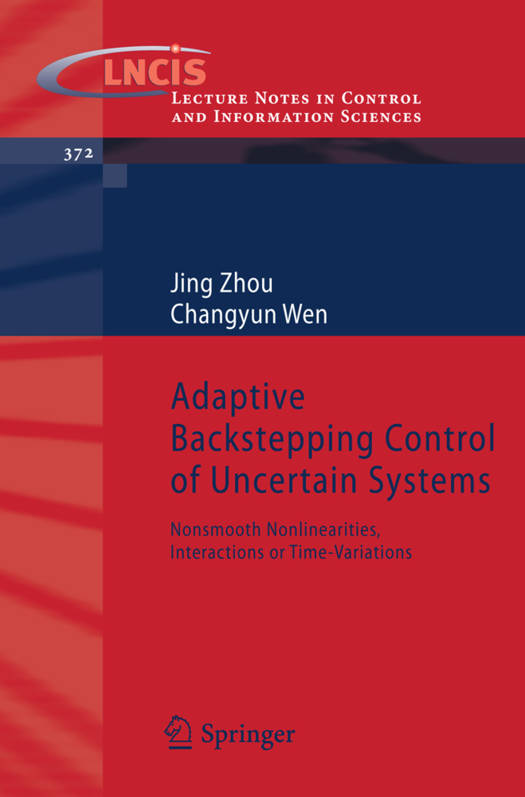
Adaptive Backstepping Control of Uncertain Systems
Nonsmooth Nonlinearities, Interactions or Time-Variations
Jing Zhou, Changyun Wen
€ 108,45
+ 216 punten
Omschrijving
This book presents new methodologies for the design and analysis of adaptive control systems based on the backstepping approach. Our emphasis is on - namic uncertain systems with nonsmooth nonlinearities, such as backlash, de- zone, hysteresis and saturation, or time-varying parameters, or interactions. The backstepping approach, a recursive Lyapunov-based scheme, was p- posed in the beginning of 1990s. With this method the construction of feedback controllawsandLyapunovfunctions issystematic, followingastep-by-stepal- rithm. Backstepping can be used to relax the matching condition, which blocked the traditional Lyapunov-based design. A major advantage of backstepping is that it has the ?exibility to avoid cancellations of useful nonlinearities and achieve regulation and tracking properties. The technique was comprehensively addressed by Krstic, Kanellakopoulos and Kokotovic in [1]. However, there is still no monograph available to address problems such as the handling of n- smooth nonlinearities, time varying parameters and system interactions using this approach. Nonsmooth nonlinearities such as dead-zone, backlash, hysteresis and satu- tion are common in industrial control systems, such as mechanical, hydraulic, biomedical, piezoelectric, and physical systems. Such nonlinearities are usually poorlyknownandmayvarywithtime, andthey oftenlimitsystemperformance.
Specificaties
Betrokkenen
- Auteur(s):
- Uitgeverij:
Inhoud
- Aantal bladzijden:
- 242
- Taal:
- Engels
- Reeks:
- Reeksnummer:
- nr. 372
Eigenschappen
- Productcode (EAN):
- 9783540778066
- Verschijningsdatum:
- 7/02/2008
- Uitvoering:
- Paperback
- Formaat:
- Trade paperback (VS)
- Afmetingen:
- 155 mm x 234 mm
- Gewicht:
- 385 g


Alleen bij Standaard Boekhandel
+ 216 punten op je klantenkaart van Standaard Boekhandel
Cadeau

AANGERADEN


Beoordelingen
We publiceren alleen reviews die voldoen aan de voorwaarden voor reviews. Bekijk onze voorwaarden voor reviews.