



Bedankt voor het vertrouwen het afgelopen jaar! Om jou te bedanken bieden we GRATIS verzending (in België) aan op alles gedurende de hele maand januari.
- Afhalen na 1 uur in een winkel met voorraad
- Gratis thuislevering in België vanaf € 30
- Ruim aanbod met 7 miljoen producten
Bedankt voor het vertrouwen het afgelopen jaar! Om jou te bedanken bieden we GRATIS verzending (in België) aan op alles gedurende de hele maand januari.
- Afhalen na 1 uur in een winkel met voorraad
- Gratis thuislevering in België vanaf € 30
- Ruim aanbod met 7 miljoen producten





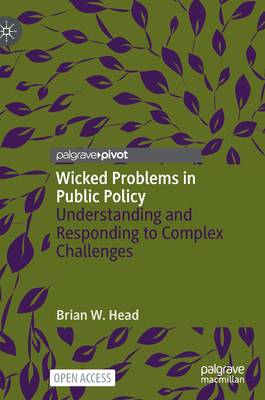
Wicked Problems in Public Policy
Understanding and Responding to Complex Challenges
Brian W Head
Hardcover | Engels
€ 91,95
+ 183 punten
Omschrijving
This is an open access book. This book offers the first overview of the 'wicked problems' literature, often seen as complex, open-ended, and intractable, with both the nature of the 'problem' and the preferred 'solution' being strongly contested. It contextualises the debate using a wide range of relevant policy examples, explaining why these issues attract so much attention.
There is an increasing interest in the conceptual and practical aspects of how 'wicked problems' are identified, understood and managed by policy practitioners. The standard public management responses to complexity and uncertainty (including traditional regulation and market-based solutions) are insufficient. Leaders often advocate and implement ideological 'quick fixes', but integrative and inclusive responses are increasingly being utilised to recognise the multiple interests and complex causes of these problems. This book uses examples from a wide rangeof social, economic and environmental fields in order to develop new insights about better solutions, and thus gain broad stakeholder acceptance for shared strategies for tackling 'wicked problems'.
There is an increasing interest in the conceptual and practical aspects of how 'wicked problems' are identified, understood and managed by policy practitioners. The standard public management responses to complexity and uncertainty (including traditional regulation and market-based solutions) are insufficient. Leaders often advocate and implement ideological 'quick fixes', but integrative and inclusive responses are increasingly being utilised to recognise the multiple interests and complex causes of these problems. This book uses examples from a wide rangeof social, economic and environmental fields in order to develop new insights about better solutions, and thus gain broad stakeholder acceptance for shared strategies for tackling 'wicked problems'.
Specificaties
Betrokkenen
- Auteur(s):
- Uitgeverij:
Inhoud
- Aantal bladzijden:
- 176
- Taal:
- Engels
Eigenschappen
- Productcode (EAN):
- 9783030945794
- Verschijningsdatum:
- 4/03/2022
- Uitvoering:
- Hardcover
- Formaat:
- Genaaid
- Afmetingen:
- 148 mm x 210 mm
- Gewicht:
- 376 g


Alleen bij Standaard Boekhandel
+ 183 punten op je klantenkaart van Standaard Boekhandel
CADEAU


Beoordelingen
We publiceren alleen reviews die voldoen aan de voorwaarden voor reviews. Bekijk onze voorwaarden voor reviews.