



Bedankt voor het vertrouwen het afgelopen jaar! Om jou te bedanken bieden we GRATIS verzending (in België) aan op alles gedurende de hele maand januari.
- Afhalen na 1 uur in een winkel met voorraad
- In januari gratis thuislevering in België
- Ruim aanbod met 7 miljoen producten
Bedankt voor het vertrouwen het afgelopen jaar! Om jou te bedanken bieden we GRATIS verzending (in België) aan op alles gedurende de hele maand januari.
- Afhalen na 1 uur in een winkel met voorraad
- In januari gratis thuislevering in België
- Ruim aanbod met 7 miljoen producten





€ 167,95
+ 335 punten
Uitvoering
Omschrijving
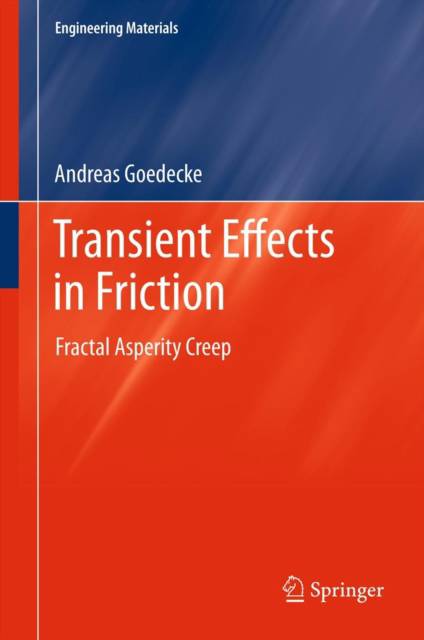
Transient friction effects determine the behavior of a wide class of mechatronic systems. Classic examples are squealing brakes, stiction in robotic arms, or stick-slip in linear drives. To properly design and understand mechatronic systems of this type, good quantitative models of transient friction effects are of primary interest. The theory developed in this book approaches this problem bottom-up, by deriving the behavior of macroscopic friction surfaces from the microscopic surface physics. The model is based on two assumptions: First, rough surfaces are inherently fractal, exhibiting roughness on a wide range of scales. Second, transient friction effects are caused by creep enlargement of the real area of contact between two bodies. This work demonstrates the results of extensive Finite Element analyses of the creep behavior of surface asperities, and proposes a generalized multi-scale area iteration for calculating the time-dependent real contact between two bodies. The toolset is then demonstrated both for the reproduction of a variety of experimental results on transient friction as well as for system simulations of two example systems.
Specificaties
Betrokkenen
- Auteur(s):
- Uitgeverij:
Inhoud
- Aantal bladzijden:
- 197
- Taal:
- Engels
- Reeks:
Eigenschappen
- Productcode (EAN):
- 9783709115053
- Verschijningsdatum:
- 24/05/2013
- Uitvoering:
- Hardcover
- Formaat:
- Genaaid
- Afmetingen:
- 157 mm x 234 mm
- Gewicht:
- 430 g



Alleen bij Standaard Boekhandel
+ 335 punten op je klantenkaart van Standaard Boekhandel
SOLDEN


Beoordelingen
We publiceren alleen reviews die voldoen aan de voorwaarden voor reviews. Bekijk onze voorwaarden voor reviews.