



Je cadeautjes zeker op tijd in huis hebben voor de feestdagen? Kom langs in onze winkels en vind het perfecte geschenk!
- Afhalen na 1 uur in een winkel met voorraad
- Gratis thuislevering in België vanaf € 30
- Ruim aanbod met 7 miljoen producten
Je cadeautjes zeker op tijd in huis hebben voor de feestdagen? Kom langs in onze winkels en vind het perfecte geschenk!
- Afhalen na 1 uur in een winkel met voorraad
- Gratis thuislevering in België vanaf € 30
- Ruim aanbod met 7 miljoen producten





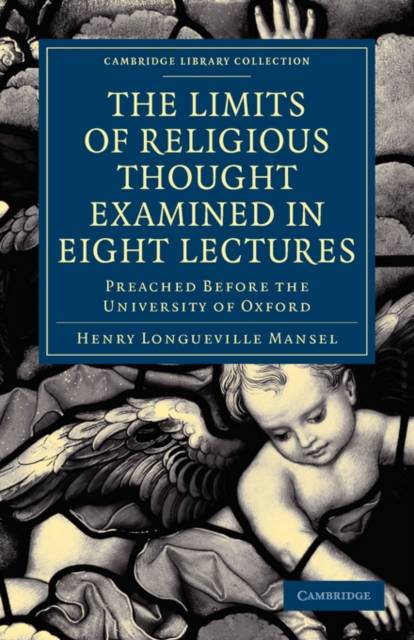
The Limits of Religious Thought Examined in Eight Lectures
Preached before the University of Oxford, in the Year M.DCCC.LVIII on the Foundation of the Late Rev. John Bampton
Henry Longueville Mansel
€ 39,45
+ 78 punten
Omschrijving
The Bampton lectures at Oxford, founded by the bequest of John Bampton in order to examine ideas from Christian theology, have taken place regularly since 1780. In 1858 the philosopher Henry Longueville Mansel delivered the set of eight lectures reissued in this volume. Mansel expresses the view - influenced by Kant and Hamilton - that the human mind is 'conditioned' and that human knowledge is strictly limited to the finite. Humans cannot attain any positive conception of the nature of the 'Absolute and Infinite Being' with certainty. We only have an imperfect representation of God and the divine through their analogy to finite things. And yet, God exists. Mansel asserts that God cannot be understood by reason but should be accepted by faith. His book ignited a bitter controversy with the Christian socialist theologian Frederick Maurice, and remains of interest to historians of philosophy and theology to this day.
Specificaties
Betrokkenen
- Auteur(s):
- Uitgeverij:
Inhoud
- Aantal bladzijden:
- 404
- Taal:
- Engels
- Reeks:
Eigenschappen
- Productcode (EAN):
- 9781108000574
- Verschijningsdatum:
- 20/07/2009
- Uitvoering:
- Paperback
- Formaat:
- Trade paperback (VS)
- Afmetingen:
- 140 mm x 216 mm
- Gewicht:
- 512 g


Alleen bij Standaard Boekhandel
+ 78 punten op je klantenkaart van Standaard Boekhandel
CADEAU


Beoordelingen
We publiceren alleen reviews die voldoen aan de voorwaarden voor reviews. Bekijk onze voorwaarden voor reviews.