



Bedankt voor het vertrouwen het afgelopen jaar! Om jou te bedanken bieden we GRATIS verzending (in België) aan op alles gedurende de hele maand januari.
- Afhalen na 1 uur in een winkel met voorraad
- In januari gratis thuislevering in België
- Ruim aanbod met 7 miljoen producten
Bedankt voor het vertrouwen het afgelopen jaar! Om jou te bedanken bieden we GRATIS verzending (in België) aan op alles gedurende de hele maand januari.
- Afhalen na 1 uur in een winkel met voorraad
- In januari gratis thuislevering in België
- Ruim aanbod met 7 miljoen producten





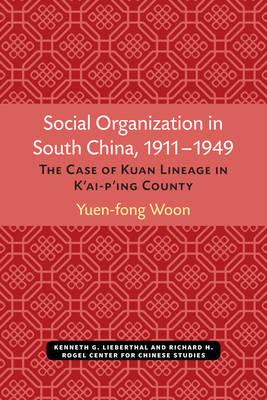
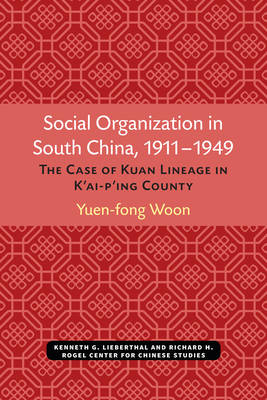
Social Organization in South China, 1911-1949
The Case of Kuan Lineage in K'ai-p'ing County
Yuen-Fong Woon
€ 25,45
+ 50 punten
Omschrijving
Bridging the collapse of the Confucian state and the establishment of the People's Republic of China, the period 1911-49 is particularly fascinating to historians, anthropologists, sociologists and political scientists. Unfortunately, it is also a very confusing period, full of shifts and changes in economic, social, and political organizations. The social implications of these changes, and the relationships between officials on the subdistrict level, the unofficial leaders, and the bulk of the peasantry remain inadequately known. South China, which nurtured the Communist Party in its formative years, is a particularly interesting case. In this study I use the Kuan lineage of K'ai-p'ing as a case study to show the effects of demographic, economic, administrative, and educational changes after the Treaty of Nanking (1842) on patrilineal kinship as a principle of social organization in South China. [vii]
Specificaties
Betrokkenen
- Auteur(s):
- Uitgeverij:
Inhoud
- Aantal bladzijden:
- 176
- Taal:
- Engels
- Reeks:
Eigenschappen
- Productcode (EAN):
- 9780892640485
- Verschijningsdatum:
- 1/01/1984
- Uitvoering:
- Paperback
- Formaat:
- Trade paperback (VS)
- Afmetingen:
- 152 mm x 229 mm
- Gewicht:
- 263 g


Alleen bij Standaard Boekhandel
+ 50 punten op je klantenkaart van Standaard Boekhandel
SOLDEN


Beoordelingen
We publiceren alleen reviews die voldoen aan de voorwaarden voor reviews. Bekijk onze voorwaarden voor reviews.