



Bedankt voor het vertrouwen het afgelopen jaar! Om jou te bedanken bieden we GRATIS verzending (in België) aan op alles gedurende de hele maand januari.
- Afhalen na 1 uur in een winkel met voorraad
- In januari gratis thuislevering in België
- Ruim aanbod met 7 miljoen producten
Bedankt voor het vertrouwen het afgelopen jaar! Om jou te bedanken bieden we GRATIS verzending (in België) aan op alles gedurende de hele maand januari.
- Afhalen na 1 uur in een winkel met voorraad
- In januari gratis thuislevering in België
- Ruim aanbod met 7 miljoen producten





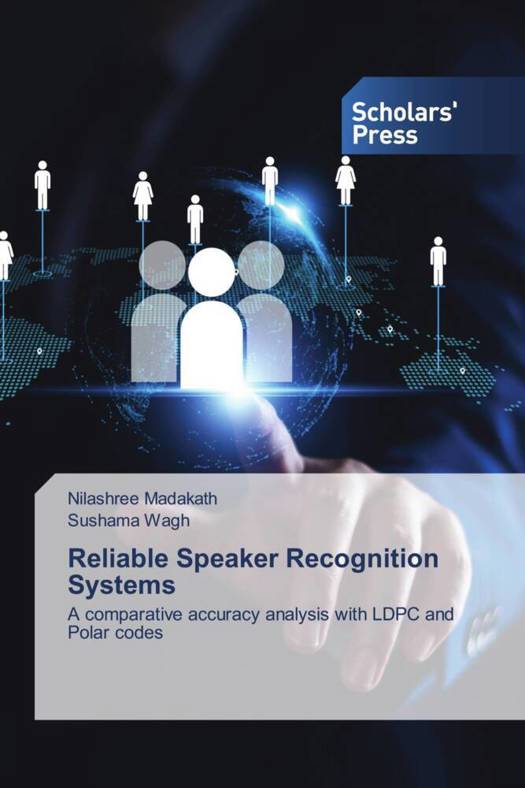
Reliable Speaker Recognition Systems
A comparative accuracy analysis with LDPC and Polar codes. DE
Nilashree Madakath, Sushama Wagh
Paperback | Engels
€ 105,95
+ 211 punten
Omschrijving
In recent years, while speaker recognition holds considerable promise, its widespread adoption has been hindered by suboptimal performance marked by its low accuracy and reliability issues. However, addressing these challenges is essential to fully exploit the capabilities of voice biometric recognition with surveys indicating preference for voice biometrics. In situations where remote speaker biometric authentication is employed, maintaining the integrity of extracted cepstral feature vectors becomes paramount in presence of channel noise. To enhance the accuracy of speaker recognition in remote applications, a novel approach is proposed where Low-Density Parity-Check (LDPC) codes and Polar codes are used for both storage and transmission of extracted Mel-frequency cepstral coefficients (MFCC) derived from voice samples. Four proposed and implemented methods are described which result in the lower bit error rates over noisy channels as well as high accuracy rate for remote speaker recognition system. This book concludes with the suggestive use of LDPC and Polar coding as an integral part of remote speaker recognition as a part of multimodal biometric authentication system.
Specificaties
Betrokkenen
- Auteur(s):
- Uitgeverij:
Inhoud
- Aantal bladzijden:
- 140
- Taal:
- Engels
Eigenschappen
- Productcode (EAN):
- 9783639718621
- Verschijningsdatum:
- 15/01/2025
- Uitvoering:
- Paperback
- Formaat:
- Trade paperback (VS)
- Afmetingen:
- 152 mm x 229 mm
- Gewicht:
- 195 g


Alleen bij Standaard Boekhandel
+ 211 punten op je klantenkaart van Standaard Boekhandel
SOLDEN


Beoordelingen
We publiceren alleen reviews die voldoen aan de voorwaarden voor reviews. Bekijk onze voorwaarden voor reviews.