



Je cadeautjes zeker op tijd in huis hebben voor de feestdagen? Kom langs in onze winkels en vind het perfecte geschenk!
- Afhalen na 1 uur in een winkel met voorraad
- Gratis thuislevering in België vanaf € 30
- Ruim aanbod met 7 miljoen producten
Je cadeautjes zeker op tijd in huis hebben voor de feestdagen? Kom langs in onze winkels en vind het perfecte geschenk!
- Afhalen na 1 uur in een winkel met voorraad
- Gratis thuislevering in België vanaf € 30
- Ruim aanbod met 7 miljoen producten





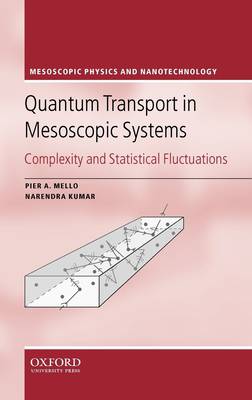
Quantum Transport in Mesoscopic Systems
Complexity and Statistical Fluctuations
Pier A Mello, Narendra Kumar
€ 322,45
+ 644 punten
Omschrijving
This book presents the statistical theory of complex wave scattering and quantum transport in physical systems which have chaotic classical dynamics, as in the case of microwave cavities and quantum dots, or which possess quenched randomness, as in the case of disordered conductors - with an emphasis on mesoscopic fluctuations. The statistical regularity of the phenomena is revealed in a natural way by adopting a novel maximum-entropy approach. Shannon's information entropy is maximised, subject to the symmetries and constraints which are physically relevant, within the powerful and non-perturbative theory of random matrices; this is a most distinctive feature of the book. Aiming for a self-contained presentation, the quantum theory of scattering, set in the context of quasi-one-dimensional, multichannel systems, and related directly to scattering problems in mesoscopic physics, is introduced in chapters two and three. The linear-response theory of quantum electronic transport, adapted to the context of mesoscopic systems, is discussed in chapter four. These chapters, together with chapter five on the maximum-entropy approach and chapter eight on weak localization, have been written in a most pedagogical style, suitable for use on graduate courses. In chapters six and seven, the problem of electronic transport through classically chaotic cavities and quasi-one-dimensional disordered systems is discussed. Many exercises are included, most of which are worked through in detail, aiding graduate students, teachers, and research scholars interested in the subject of quantum transport through disordered and chaotic systems.
Specificaties
Betrokkenen
- Auteur(s):
- Uitgeverij:
Inhoud
- Aantal bladzijden:
- 416
- Taal:
- Engels
- Reeks:
- Reeksnummer:
- nr. 4
Eigenschappen
- Productcode (EAN):
- 9780198525820
- Verschijningsdatum:
- 15/07/2004
- Uitvoering:
- Hardcover
- Formaat:
- Genaaid
- Afmetingen:
- 156 mm x 234 mm
- Gewicht:
- 757 g


Alleen bij Standaard Boekhandel
+ 644 punten op je klantenkaart van Standaard Boekhandel
CADEAU


Beoordelingen
We publiceren alleen reviews die voldoen aan de voorwaarden voor reviews. Bekijk onze voorwaarden voor reviews.