


- Afhalen na 1 uur in een winkel met voorraad
- Gratis thuislevering in België vanaf € 30
- Ruim aanbod met 7 miljoen producten
- Afhalen na 1 uur in een winkel met voorraad
- Gratis thuislevering in België vanaf € 30
- Ruim aanbod met 7 miljoen producten





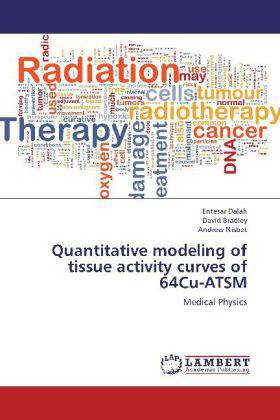
Quantitative modeling of tissue activity curves of 64Cu-ATSM
Medical Physics
Entesar Dalah, David Bradley, Andrew Nisbet
Paperback | Engels
€ 67,45
+ 134 punten
Omschrijving
The molecular imaging modality of PET in conjunction with radio-labelled molecules that undergo chemical changes inside tumors as a result of the presence or absence of oxygen, has become a promising technique for the non-invasive quantification of tumor hypoxia. Herein the relationship between tumor hypoxia and vasculature geometry is considered using a novel mathematical approach, likewise the spatiotemporal distribution of hypoxia PET sensitive tracer of, 64Cu-ATSM, is determined. Representation of oxygen distribution in 2-D vascular architechure using a reaction diffusion model enables quantitative relationships to be obtained, specifically between tissue diffusivity, tissue metabolism, anatomical structure of blood vessels and oxygen gradients. Simiarly, tissue activity curves (TACs) are a potential key in providing information on cellular perfusion and limited-diffusion. In this work a development to the work of Kelly and Brady (2006) is described and verified, with a particular interest in simulating TACs of the most promising hypoxia PET sensitive tracer, 64Cu-ATSM.
Specificaties
Betrokkenen
- Auteur(s):
- Uitgeverij:
Inhoud
- Aantal bladzijden:
- 176
- Taal:
- Engels
Eigenschappen
- Productcode (EAN):
- 9783659266287
- Uitvoering:
- Paperback
- Afmetingen:
- 150 mm x 220 mm


Alleen bij Standaard Boekhandel
+ 134 punten op je klantenkaart van Standaard Boekhandel
AANGERADEN


Beoordelingen
We publiceren alleen reviews die voldoen aan de voorwaarden voor reviews. Bekijk onze voorwaarden voor reviews.