


- Afhalen na 1 uur in een winkel met voorraad
- Gratis thuislevering in België vanaf € 30
- Ruim aanbod met 7 miljoen producten
- Afhalen na 1 uur in een winkel met voorraad
- Gratis thuislevering in België vanaf € 30
- Ruim aanbod met 7 miljoen producten





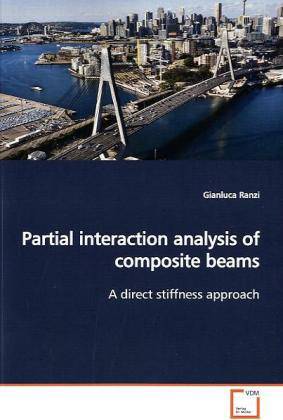
Partial interaction analysis of composite beams
A direct stiffness approach
Gianluca Ranzi
Paperback | Engels
€ 77,95
+ 155 punten
Omschrijving
Steel-concrete composite construction has been gaining popularity over the last century thanks to its ability to well marry the advantages of structural components made of concrete and steel. This work studies the behaviour of composite beams with partial shear interaction by means of the direct stiffness approach. An analytical model is presented to describe the behaviour of m-layered composite beams. For the particular case of two layers closed form solutions are derived to predict the composite behaviour in the linear-elastic range and accounting for time effects. Based on this model, a direct stiffness approach is formulated considering linear-elastic material properties. An extension in the nonlinear range is proposed and validated against experimental data available in the literature. The applicability of this approach is further extended to account for the time-dependent behaviour of the concrete. In this case only one discretisation is necessary, i.e. in the time domain, instead of the two, i.e. one discretisation in the time domain and one along the beam axis, required by modelling techniques available in the literature.
Specificaties
Betrokkenen
- Auteur(s):
- Uitgeverij:
Inhoud
- Aantal bladzijden:
- 480
- Taal:
- Engels
Eigenschappen
- Productcode (EAN):
- 9783639166293
- Verschijningsdatum:
- 14/06/2009
- Uitvoering:
- Paperback
- Formaat:
- Trade paperback (VS)
- Afmetingen:
- 152 mm x 229 mm
- Gewicht:
- 698 g


Alleen bij Standaard Boekhandel
+ 155 punten op je klantenkaart van Standaard Boekhandel
Cadeau

AANGERADEN


Beoordelingen
We publiceren alleen reviews die voldoen aan de voorwaarden voor reviews. Bekijk onze voorwaarden voor reviews.