



Bedankt voor het vertrouwen het afgelopen jaar! Om jou te bedanken bieden we GRATIS verzending (in België) aan op alles gedurende de hele maand januari.
- Afhalen na 1 uur in een winkel met voorraad
- Gratis thuislevering in België vanaf € 30
- Ruim aanbod met 7 miljoen producten
Bedankt voor het vertrouwen het afgelopen jaar! Om jou te bedanken bieden we GRATIS verzending (in België) aan op alles gedurende de hele maand januari.
- Afhalen na 1 uur in een winkel met voorraad
- Gratis thuislevering in België vanaf € 30
- Ruim aanbod met 7 miljoen producten





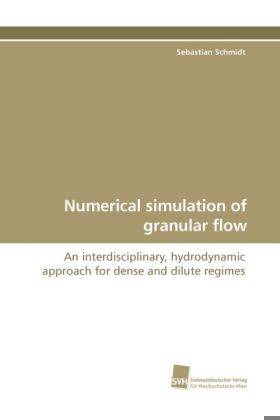
Numerical Simulation of Granular Flow
An interdisciplinary, hydrodynamic approach for dense and dilute regimes
Sebastian Schmidt
Paperback | Engels
€ 115,95
+ 231 punten
Omschrijving
In the broad field of numerical simulation of granular flow, many distinct challenges are faced. Aside from the nontrivial task of defining ``granular flow'', the first challenge is its modeling. Still no common scientific agreement has been reached for the exact equations. The vast majority of publications distinctively treats either dilute or dense regimes. Common to nearly all models, the contained equations in their full complexity are very difficult to solve by available numerical methods. The author develops an interdisciplinary approach to the simulation of granular flow in all regimes using a hydrodynamic view on modeling. A system of partial differential equations and constitutive relations is derived through the kinetic theory of granular gases with extensions from soil mechanics. The author introduces a novel nonlinear fractional step approach, which is able to numerically obtain approximate solutions. The simulation method, including modeling and numerics is implemented within a software framework for the generic solution of complex rheology problems developed by the author which results in this in-itself closed method for the numerical simulation of granular flow.
Specificaties
Betrokkenen
- Auteur(s):
- Uitgeverij:
Inhoud
- Aantal bladzijden:
- 156
- Taal:
- Engels
Eigenschappen
- Productcode (EAN):
- 9783838110431
- Verschijningsdatum:
- 17/09/2009
- Uitvoering:
- Paperback
- Formaat:
- Trade paperback (VS)
- Afmetingen:
- 152 mm x 229 mm
- Gewicht:
- 217 g


Alleen bij Standaard Boekhandel
+ 231 punten op je klantenkaart van Standaard Boekhandel
CADEAU


Beoordelingen
We publiceren alleen reviews die voldoen aan de voorwaarden voor reviews. Bekijk onze voorwaarden voor reviews.