



Bedankt voor het vertrouwen het afgelopen jaar! Om jou te bedanken bieden we GRATIS verzending (in België) aan op alles gedurende de hele maand januari.
- Afhalen na 1 uur in een winkel met voorraad
- Gratis thuislevering in België vanaf € 30
- Ruim aanbod met 7 miljoen producten
Bedankt voor het vertrouwen het afgelopen jaar! Om jou te bedanken bieden we GRATIS verzending (in België) aan op alles gedurende de hele maand januari.
- Afhalen na 1 uur in een winkel met voorraad
- Gratis thuislevering in België vanaf € 30
- Ruim aanbod met 7 miljoen producten





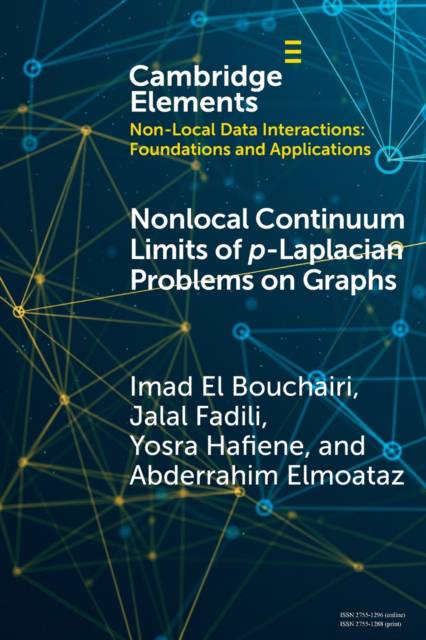
Nonlocal Continuum Limits of p-Laplacian Problems on Graphs
Imad El Bouchairi, Jalal Fadili, Yosra Hafiene
€ 33,45
+ 66 punten
Omschrijving
In this Element, the authors consider fully discretized p-Laplacian problems (evolution, boundary value and variational problems) on graphs. The motivation of nonlocal continuum limits comes from the quest of understanding collective dynamics in large ensembles of interacting particles, which is a fundamental problem in nonlinear science, with applications ranging from biology to physics, chemistry and computer science. Using the theory of graphons, the authors give a unified treatment of all the above problems and establish the continuum limit for each of them together with non-asymptotic convergence rates. They also describe an algorithmic framework based proximal splitting to solve these discrete problems on graphs.
Specificaties
Betrokkenen
- Auteur(s):
- Uitgeverij:
Inhoud
- Aantal bladzijden:
- 124
- Taal:
- Engels
- Reeks:
Eigenschappen
- Productcode (EAN):
- 9781009327855
- Verschijningsdatum:
- 11/05/2023
- Uitvoering:
- Paperback
- Formaat:
- Trade paperback (VS)
- Afmetingen:
- 152 mm x 229 mm
- Gewicht:
- 176 g


Alleen bij Standaard Boekhandel
+ 66 punten op je klantenkaart van Standaard Boekhandel
CADEAU


Beoordelingen
We publiceren alleen reviews die voldoen aan de voorwaarden voor reviews. Bekijk onze voorwaarden voor reviews.