


- Afhalen na 1 uur in een winkel met voorraad
- Gratis thuislevering in België vanaf € 30
- Ruim aanbod met 7 miljoen producten
- Afhalen na 1 uur in een winkel met voorraad
- Gratis thuislevering in België vanaf € 30
- Ruim aanbod met 7 miljoen producten





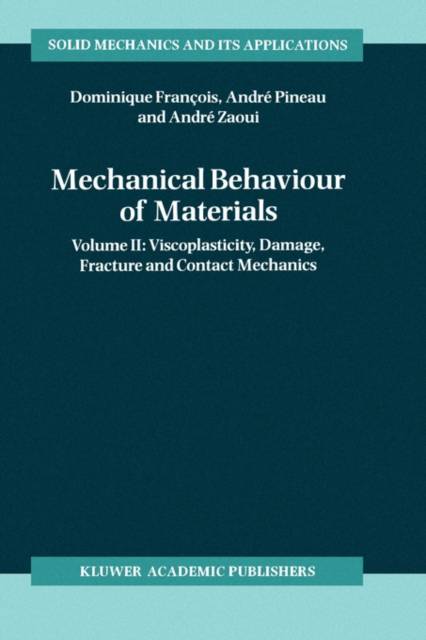
Mechanical Behaviour of Materials
Volume II: Viscoplasticity, Damage, Fracture and Contact Mechanics
Dominique François, André Pineau, André Zaoui
€ 181,95
+ 363 punten
Uitvoering
Omschrijving
Designing new structural materials, extending lifetimes and guarding against fracture in service are among the preoccupations of engineers, and to deal with these they need to have command of the mechanics of material behaviour. The first volume of this two-volume work deals with elastic and elastoplastic behaviour; this second volume continues with viscoelasticity, damage, fracture (resistance to cracking) and contact mechanics. As in Volume I, the treatment starts from the active mechanisms on the microscopic scale and develops the laws of macroscopic behaviour. Chapter I deals with viscoplastic behaviour, as shown, for example, at low temperatures by the effects of oscillatory loads and at high temperatures by creep under steady load. Chapter 2 treats damage phenomena encountered in all materials - for example, metals, polymers, glasses, concretes - such as cavitation, fatigue and stress-corrosion cracking. Chapter 3 treats those concepts of fracture mechanics that are needed for the understanding of resistance to cracking and Chapter 4 completes the volume with a survey of the main concepts of contact mechanics. As with Volume I, each chapter has a set of exercises, either with solutions or with indications of how to attack the problem; and there are many explanatory diagrams and other illustrations.
Specificaties
Betrokkenen
- Auteur(s):
- Uitgeverij:
Inhoud
- Aantal bladzijden:
- 410
- Taal:
- Engels
- Reeks:
- Reeksnummer:
- nr. 58
Eigenschappen
- Productcode (EAN):
- 9780792348955
- Verschijningsdatum:
- 30/11/1998
- Uitvoering:
- Hardcover
- Formaat:
- Genaaid
- Afmetingen:
- 156 mm x 234 mm
- Gewicht:
- 766 g



Alleen bij Standaard Boekhandel
+ 363 punten op je klantenkaart van Standaard Boekhandel
AANGERADEN


Beoordelingen
We publiceren alleen reviews die voldoen aan de voorwaarden voor reviews. Bekijk onze voorwaarden voor reviews.