



Bedankt voor het vertrouwen het afgelopen jaar! Om jou te bedanken bieden we GRATIS verzending (in België) aan op alles gedurende de hele maand januari.
- Afhalen na 1 uur in een winkel met voorraad
- In januari gratis thuislevering in België
- Ruim aanbod met 7 miljoen producten
Bedankt voor het vertrouwen het afgelopen jaar! Om jou te bedanken bieden we GRATIS verzending (in België) aan op alles gedurende de hele maand januari.
- Afhalen na 1 uur in een winkel met voorraad
- In januari gratis thuislevering in België
- Ruim aanbod met 7 miljoen producten





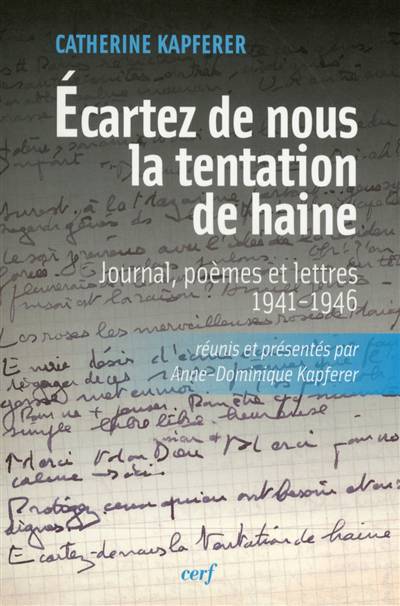
Ecartez de nous la tentation de haine
journal, poèmes et lettres, 1941-1946
Anne-Dominique Kapferer
Paperback | Frans
€ 28,00
+ 56 punten
Omschrijving
Ni un roman, ni un essai, ni une chronique... Couvrant la période de 1941 à 1946 voici le journal authentique et les poèmes écrits par une jeune étudiante française de famille juive et chrétienne, à Paris et en Normandie. De 17 à 22 ans elle a écrit ces pages qui font écho à ses activités, à ses émotions et à celles de ses amis et qui témoignent de ses rencontres et de sa foi pendant la Seconde Guerre Mondiale. Cachant volontairement jusqu'en 1942 les aspects les plus noirs de l'Occupation — parce qu'elle a peur — elle se contente de relater le plus calmement possible les petits faits de sa vie quotidienne (un exposé d'histoire à préparer pour la Sorbonne, la police allemande dans le métro, la cueillette des mûres dans un chemin forestier, les premiers pas d'un bébé dont le père, résistant, mourra déporté...). Jusqu'en 1942, Dieu paraît absent et l'angoisse est cachée. Mais dès le mois d'avril 42, alors que l'étreinte et l'horreur de l'Occupation nazie s'amplifient, Dieu devient le premier interlocuteur, le confident et l'allié qui sait pardonner. Les cris et les silences étouffés deviennent des flammes dans des pages et des poèmes presque mystiques. Au lendemain de son baptême dans la nuit de Noël 1943, elle quitte Paris sous une fausse identité, et c'est près de Nemours, au sud-est de Fontainebleau, travaillant dans une Maison-Refuge d'enfants de la banlieue parisienne bombardée, qu'elle verra les premiers tanks du débarquement et dansera avec les soldats américains. Enfin en 1945, ce sera pour elle la découverte de la réalité des camps et du difficile retour à une vie qui ne qui ne pourra jamais ressembler à la vie d'avant-guerre.
--
Neither a novel, nor an essay, nor a chronicle... Covering the period from 1941 to 1946, here are the actual diary and poems written in Paris and Normandy by a young French student of mixed Jewish and Christian descent. She wrote these pages between the ages of 17 and 22, describing her activities and emotions and those of her friends, and telling of her encounters and her faith during the Second World War. Deliberately concealing the darkest aspects of the Occupation until 1942—though fear—she contents herself with recounting, as calmly as possible, the mundane facts of her everyday existence (a history exposé to write for the Sorbonne, the German police in the Metro, picking blackberries on a forest path, the first steps of a baby whose father, a Resistant, died after being deported...). Up till 1942, God seems to be absent and fear is concealed. But, from April '42, when the grip and horror of the Nazi Occupation gains momentum, God becomes her principal interlocutor and confidant, the ally who can forgive. The stifled silence and cries are aflame in these almost mystical pages and poems. The day following her Baptism on Christmas Eve 1943, she left Paris under a false identity, and it was near Nemours, south-east of Fontainebleau, while she was working in a refuge for children from the bombed Parisian suburbs, that she saw the first tanks from the Normandy landings and danced with the American soldiers. Finally, in 1945, she discovered the reality of the concentration camps and the difficult return to a life which could never resemble her pre-War existence.
--
Neither a novel, nor an essay, nor a chronicle... Covering the period from 1941 to 1946, here are the actual diary and poems written in Paris and Normandy by a young French student of mixed Jewish and Christian descent. She wrote these pages between the ages of 17 and 22, describing her activities and emotions and those of her friends, and telling of her encounters and her faith during the Second World War. Deliberately concealing the darkest aspects of the Occupation until 1942—though fear—she contents herself with recounting, as calmly as possible, the mundane facts of her everyday existence (a history exposé to write for the Sorbonne, the German police in the Metro, picking blackberries on a forest path, the first steps of a baby whose father, a Resistant, died after being deported...). Up till 1942, God seems to be absent and fear is concealed. But, from April '42, when the grip and horror of the Nazi Occupation gains momentum, God becomes her principal interlocutor and confidant, the ally who can forgive. The stifled silence and cries are aflame in these almost mystical pages and poems. The day following her Baptism on Christmas Eve 1943, she left Paris under a false identity, and it was near Nemours, south-east of Fontainebleau, while she was working in a refuge for children from the bombed Parisian suburbs, that she saw the first tanks from the Normandy landings and danced with the American soldiers. Finally, in 1945, she discovered the reality of the concentration camps and the difficult return to a life which could never resemble her pre-War existence.
Specificaties
Betrokkenen
- Auteur(s):
- Uitgeverij:
Inhoud
- Aantal bladzijden:
- 318
- Taal:
- Frans
Eigenschappen
- Productcode (EAN):
- 9782204092043
- Verschijningsdatum:
- 6/06/2011
- Uitvoering:
- Paperback
- Afmetingen:
- 150 mm x 220 mm
- Gewicht:
- 453 g


Alleen bij Standaard Boekhandel
+ 56 punten op je klantenkaart van Standaard Boekhandel
SOLDEN


Beoordelingen
We publiceren alleen reviews die voldoen aan de voorwaarden voor reviews. Bekijk onze voorwaarden voor reviews.