



Je cadeautjes zeker op tijd in huis hebben voor de feestdagen? Kom langs in onze winkels en vind het perfecte geschenk!
- Afhalen na 1 uur in een winkel met voorraad
- Gratis thuislevering in België vanaf € 30
- Ruim aanbod met 7 miljoen producten
Je cadeautjes zeker op tijd in huis hebben voor de feestdagen? Kom langs in onze winkels en vind het perfecte geschenk!
- Afhalen na 1 uur in een winkel met voorraad
- Gratis thuislevering in België vanaf € 30
- Ruim aanbod met 7 miljoen producten





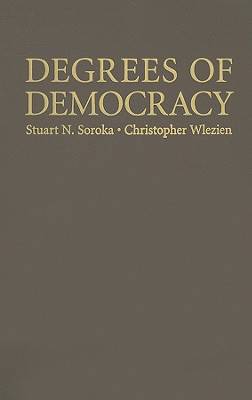
Degrees of Democracy
Politics, Public Opinion, and Policy
Stuart N Soroka, Christopher Wlezien
Hardcover | Engels
€ 122,95
+ 245 punten
Omschrijving
This book develops and tests a "thermostatic" model of public opinion and policy, in which preferences for policy both drive and adjust to changes in policy. The representation of opinion in policy is central to democratic theory and everyday politics. So too is the extent to which public preferences are informed and responsive to changes in policy. The coexistence of both "public responsiveness" and "policy representation" is thus a defining characteristic of successful democratic governance, and the subject of this book. The authors examine both responsiveness and representation across a range of policy domains in the United States, the United Kingdom, and Canada. The story that emerges is one in which representative democratic government functions surprisingly well, though there are important differences in the details. Variations in public responsiveness and policy representation responsiveness are found to reflect the "salience" of the different domains and governing institutions - specifically, presidentialism (versus parliamentarism) and federalism (versus unitary government).
Specificaties
Betrokkenen
- Auteur(s):
- Uitgeverij:
Inhoud
- Aantal bladzijden:
- 254
- Taal:
- Engels
Eigenschappen
- Productcode (EAN):
- 9780521868334
- Verschijningsdatum:
- 14/12/2009
- Uitvoering:
- Hardcover
- Formaat:
- Genaaid
- Afmetingen:
- 152 mm x 229 mm
- Gewicht:
- 498 g


Alleen bij Standaard Boekhandel
+ 245 punten op je klantenkaart van Standaard Boekhandel
CADEAU


Beoordelingen
We publiceren alleen reviews die voldoen aan de voorwaarden voor reviews. Bekijk onze voorwaarden voor reviews.