



Je cadeautjes zeker op tijd in huis hebben voor de feestdagen? Kom langs in onze winkels en vind het perfecte geschenk!
- Afhalen na 1 uur in een winkel met voorraad
- Gratis thuislevering in België vanaf € 30
- Ruim aanbod met 7 miljoen producten
Je cadeautjes zeker op tijd in huis hebben voor de feestdagen? Kom langs in onze winkels en vind het perfecte geschenk!
- Afhalen na 1 uur in een winkel met voorraad
- Gratis thuislevering in België vanaf € 30
- Ruim aanbod met 7 miljoen producten





€ 341,95
+ 683 punten
Uitvoering
Omschrijving
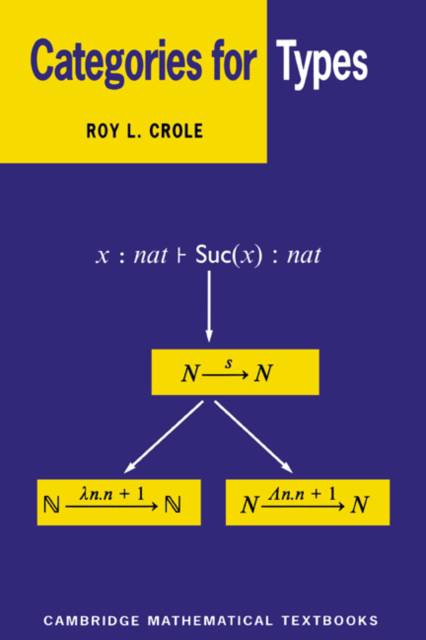
This textbook explains the basic principles of categorical type theory and the techniques used to derive categorical semantics for specific type theories. It introduces the reader to ordered set theory, lattices and domains, and this material provides plenty of examples for an introduction to category theory, which covers categories, functors, natural transformations, the Yoneda lemma, cartesian closed categories, limits, adjunctions and indexed categories. Four kinds of formal system are considered in detail, namely algebraic, functional, polymorphic functional, and higher order polymorphic functional type theory. For each of these the categorical semantics are derived and results about the type systems are proved categorically. Issues of soundness and completeness are also considered. Aimed at advanced undergraduates and beginning graduates, this book will be of interest to theoretical computer scientists, logicians and mathematicians specializing in category theory.
Specificaties
Betrokkenen
- Auteur(s):
- Uitgeverij:
Inhoud
- Aantal bladzijden:
- 356
- Taal:
- Engels
- Reeks:
Eigenschappen
- Productcode (EAN):
- 9780521450928
- Verschijningsdatum:
- 27/01/1994
- Uitvoering:
- Hardcover
- Formaat:
- Genaaid
- Afmetingen:
- 152 mm x 229 mm
- Gewicht:
- 689 g


Alleen bij Standaard Boekhandel
+ 683 punten op je klantenkaart van Standaard Boekhandel
CADEAU


Beoordelingen
We publiceren alleen reviews die voldoen aan de voorwaarden voor reviews. Bekijk onze voorwaarden voor reviews.