



Bedankt voor het vertrouwen het afgelopen jaar! Om jou te bedanken bieden we GRATIS verzending (in België) aan op alles gedurende de hele maand januari.
- Afhalen na 1 uur in een winkel met voorraad
- Gratis thuislevering in België vanaf € 30
- Ruim aanbod met 7 miljoen producten
Bedankt voor het vertrouwen het afgelopen jaar! Om jou te bedanken bieden we GRATIS verzending (in België) aan op alles gedurende de hele maand januari.
- Afhalen na 1 uur in een winkel met voorraad
- Gratis thuislevering in België vanaf € 30
- Ruim aanbod met 7 miljoen producten





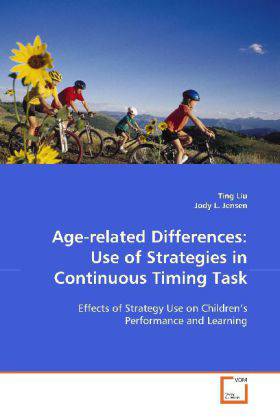
Age-related Differences: Use of Strategies in Continuous Timing Task
Effects of Strategy Use on Children s Performance and Learning
Ting Liu
Paperback | Engels
€ 58,45
+ 116 punten
Omschrijving
The purpose of this book was twofold: (a) to
associate age-related performance deficits in
younger children with the use of recall strategies,
and (b) to determine whether children who performed
poorly in the motor skill would benefit from
learning to apply a recall strategy. Two experiments
were conducted. In Experiment 1, younger children (5-
7 years) and older children (8-10 years) were asked
to recall selected pedaling cadences. Strategy was
assessed by questioning the children immediately
following the recall. In this experiment the
majority of the older children used strategies,
while the younger children did not. Children who
used strategies performed with less error than the
children who did not. In Experiment 2 then, children
with high errors in Experiment 1 were assigned to an
experimental or a control group. The children in the
experimental group were taught to use a specific
strategy to assist their recall. The results showed
that children who received the instruction in
strategy use improved their performance. Thus across
this age range, poor performance was modifiable by
explicit instruction.
associate age-related performance deficits in
younger children with the use of recall strategies,
and (b) to determine whether children who performed
poorly in the motor skill would benefit from
learning to apply a recall strategy. Two experiments
were conducted. In Experiment 1, younger children (5-
7 years) and older children (8-10 years) were asked
to recall selected pedaling cadences. Strategy was
assessed by questioning the children immediately
following the recall. In this experiment the
majority of the older children used strategies,
while the younger children did not. Children who
used strategies performed with less error than the
children who did not. In Experiment 2 then, children
with high errors in Experiment 1 were assigned to an
experimental or a control group. The children in the
experimental group were taught to use a specific
strategy to assist their recall. The results showed
that children who received the instruction in
strategy use improved their performance. Thus across
this age range, poor performance was modifiable by
explicit instruction.
Specificaties
Betrokkenen
- Auteur(s):
- Uitgeverij:
Inhoud
- Aantal bladzijden:
- 132
- Taal:
- Engels
Eigenschappen
- Productcode (EAN):
- 9783639120011
- Uitvoering:
- Paperback
- Afmetingen:
- 220


Alleen bij Standaard Boekhandel
+ 116 punten op je klantenkaart van Standaard Boekhandel
CADEAU


Beoordelingen
We publiceren alleen reviews die voldoen aan de voorwaarden voor reviews. Bekijk onze voorwaarden voor reviews.