



Bedankt voor het vertrouwen het afgelopen jaar! Om jou te bedanken bieden we GRATIS verzending (in België) aan op alles gedurende de hele maand januari.
- Afhalen na 1 uur in een winkel met voorraad
- Gratis thuislevering in België vanaf € 30
- Ruim aanbod met 7 miljoen producten
Bedankt voor het vertrouwen het afgelopen jaar! Om jou te bedanken bieden we GRATIS verzending (in België) aan op alles gedurende de hele maand januari.
- Afhalen na 1 uur in een winkel met voorraad
- Gratis thuislevering in België vanaf € 30
- Ruim aanbod met 7 miljoen producten





Omschrijving
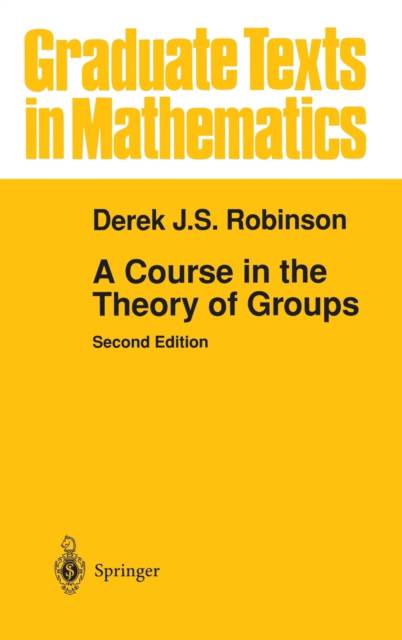
A Course in the Theory of Groups is a comprehensive introduction to the theory of groups - finite and infinite, commutative and non-commutative. Presupposing only a basic knowledge of modern algebra, it introduces the reader to the different branches of group theory and to its principal accomplishments. While stressing the unity of group theory, the book also draws attention to connections with other areas of algebra such as ring theory and homological algebra.
This new edition has been updated at various points, some proofs have been improved, and lastly about thirty additional exercises are included. There are three main additions to the book. In the chapter on group extensions an exposition of Schreier's concrete approach via factor sets is given before the introduction of covering groups. This seems to be desirable on pedagogical grounds. Then S. Thomas's elegant proof of the automorphism tower theorem is included in the section on complete groups. Finally an elementary counterexample to the Burnside problem due to N.D. Gupta has been added in the chapter on finiteness properties.
This new edition has been updated at various points, some proofs have been improved, and lastly about thirty additional exercises are included. There are three main additions to the book. In the chapter on group extensions an exposition of Schreier's concrete approach via factor sets is given before the introduction of covering groups. This seems to be desirable on pedagogical grounds. Then S. Thomas's elegant proof of the automorphism tower theorem is included in the section on complete groups. Finally an elementary counterexample to the Burnside problem due to N.D. Gupta has been added in the chapter on finiteness properties.
Specificaties
Betrokkenen
- Auteur(s):
- Uitgeverij:
Inhoud
- Aantal bladzijden:
- 502
- Taal:
- Engels
- Reeks:
- Reeksnummer:
- nr. 80
Eigenschappen
- Productcode (EAN):
- 9780387944616
- Verschijningsdatum:
- 26/10/1995
- Uitvoering:
- Hardcover
- Formaat:
- Genaaid
- Afmetingen:
- 161 mm x 242 mm
- Gewicht:
- 861 g


Alleen bij Standaard Boekhandel
+ 335 punten op je klantenkaart van Standaard Boekhandel
CADEAU


Beoordelingen
We publiceren alleen reviews die voldoen aan de voorwaarden voor reviews. Bekijk onze voorwaarden voor reviews.